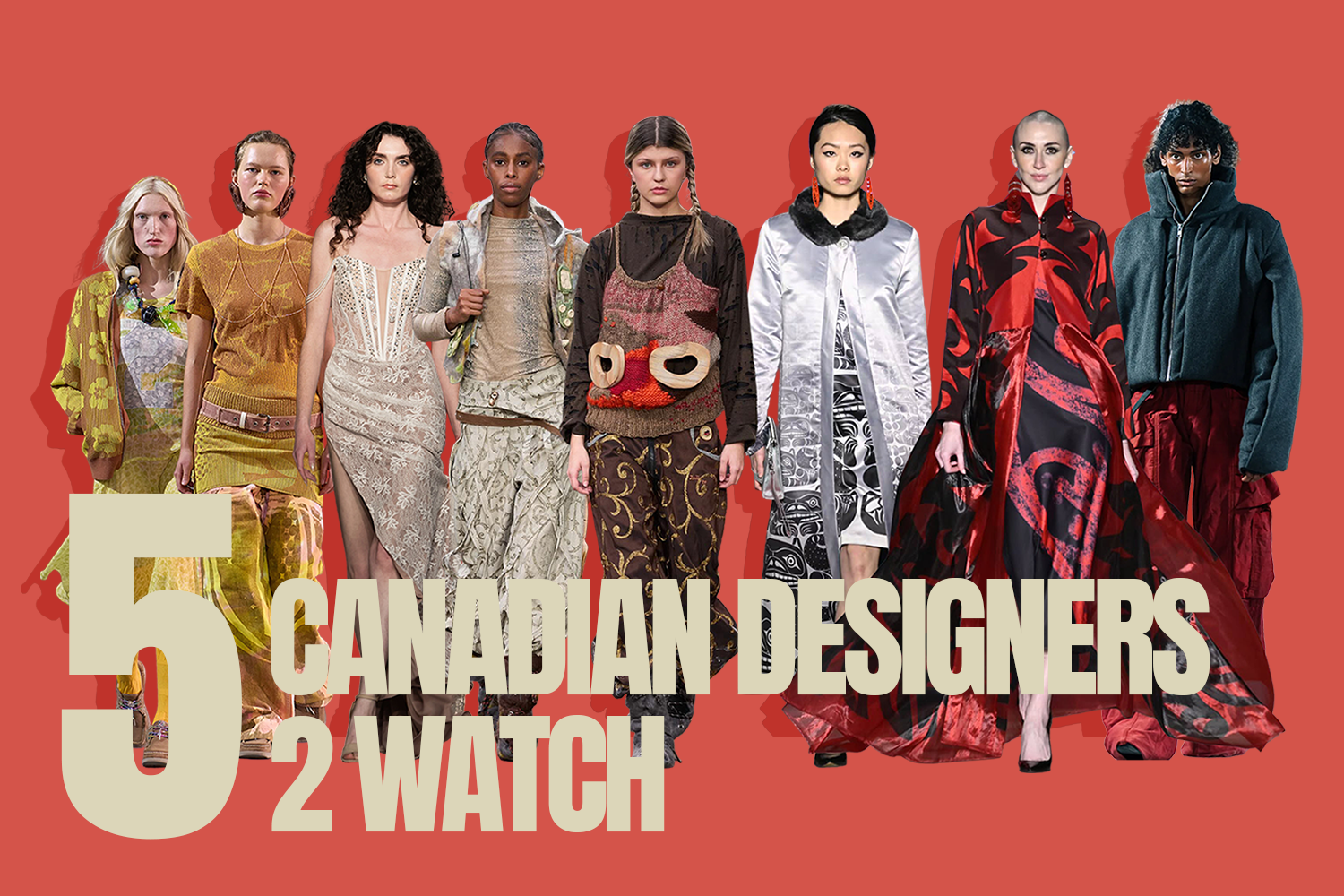
Canadian fashion is having one of those moments where the most interesting work is not necessarily coming from the country’s biggest established names. Instead, a new generation of designers is building momentum through independent studios, international fashion weeks, technical craftsmanship and a growing confidence in what Canadian fashion can look like.
For Fall/Winter 2026, that means everything from futuristic Montréal leatherwork and highly conceptual Vancouver knitwear to Coast Salish design and a Canadian-born label commanding attention in Copenhagen.
These five designers are not simply names with good archives. They are actively producing, showing and developing their brands in 2026 — and they are worth watching now.
1. Paolina Russo
Of the designers on this list, Paolina Russo has arguably achieved the strongest international momentum.
The Canadian designer, who founded her namesake label alongside French designer Lucile Guilmard, has developed an immediately recognizable aesthetic built around experimental knitwear, technical textiles and the collision between suburban nostalgia and futurism.
Russo grew up in Markham, Ontario, before studying at Central Saint Martins in London. Today the brand operates internationally and has become a regular presence at Copenhagen Fashion Week. The label has also been recognized as an LVMH Prize finalist, an International Woolmark Prize finalist and winner of the Zalando Visionary Award.
For Autumn/Winter 2026, Russo and Guilmard looked back to the feeling of a first school trip away from home. The collection translated school uniforms, rugby shirts, pleated skirts, badges and collegiate styling through the brand’s distinctive technical language. Even the badges carried NFC technology that could connect wearers digitally back to the label.
What continues to make Paolina Russo compelling is that nostalgia rarely becomes straightforward retro fashion. Traditional techniques including knitwear, macramé and tie-dye are constantly being pushed through contemporary fabrication and digital culture.
The label was already back on the Copenhagen runway in August with its Spring/Summer 2027 collection, making it clear that AW26 was not an isolated appearance but part of an active and growing international schedule.
For Canadian fashion, Russo represents something increasingly important: a designer whose Canadian identity remains part of the story without geographically limiting the brand.
Website: paolinarusso.com
Instagram: @paolina_russo
2. DUNNE CLIFF — Allison Dunne
Vancouver designer Allison Dunne approaches fashion almost as though she were writing an essay.
Her label, DUNNE CLIFF, combines artisanal knitwear with ideas drawn from history, philosophy, literature, technology and art. Rather than simply choosing a seasonal inspiration, Dunne tends to build collections around questions and contradictions.
That intellectual approach is balanced by something very tangible: craft.
Dunne’s background includes traditional hand knitting and machine knitting, influenced partly by her family’s Shetland heritage. She produces work from a small Vancouver studio and has become particularly known for developing Fair Isle knitwear in unconventional directions.
The momentum behind the label has accelerated quickly. Between 2023 and 2025, Dunne showed seasonal collections at Vancouver Fashion Week and Fashion Art Toronto, became a CAFA Fashion Design Student of the Year finalist, received the Nancy Mak Award and won Fashion Art Toronto’s FASHN DISRPTR Award. She also studied experimental fashion knitwear at Central Saint Martins in 2025.
Then came the international step.
DUNNE CLIFF showed Fall/Winter 2026 in London in February, presenting off-calendar during London Fashion Week through the Global Fashion Collective. The collection continued Dunne’s approach to clothing as narrative, combining handcrafted knitwear with ideas surrounding craft, technology, memory and the tension between heritage and innovation.
The brand also appeared at Vancouver Fashion Week FW26, confirming that Dunne remains very much part of Canada’s current design scene.
DUNNE CLIFF is particularly interesting because it sits comfortably between fashion and collectible craft. In a market filled with easily duplicated products, genuinely handmade pieces with an identifiable point of view have become increasingly valuable.
Website: dunnecliff.com
Instagram: @dunne.cliff
3. NDSCLSD — Malakai Vandelac-Douwstra
If there is a Canadian label that looks designed specifically for Fall/Winter, it may be NDSCLSD.
Founded by Montréal designer Malakai Vandelac-Douwstra, NDSCLSD operates as an independent atelier specializing in handcrafted leather goods and technical garments.
Leather jackets, cargo trousers, coats, bags and technical pieces are produced in-house using materials including full-grain cowhide, lambskin, shearling, nylon, canvas and denim. The brand also uses custom sterling-silver hardware and offers made-to-measure customization.
The aesthetic is influenced by racing, machinery, manga and science fiction, but the craftsmanship keeps the clothes from becoming costume.
Its Fall/Winter 2026 collection, THE WALK, is already fully documented by the label and spans 22 runway looks. The collection moves between padded bombers, structured leather jackets, wide trousers, technical dresses, wool outerwear and dramatically layered black leather.
The result feels like equipment from a near-future city rather than conventional luxury sportswear.
NDSCLSD also presented a separate Spring/Summer 2026 collection at Fashion Art Toronto in May, where the racing influence became even more explicit through structured silhouettes, protective forms, treated denim and technical leather construction. Fashion Art Toronto identifies the label as Montréal-based and confirms that its production remains focused on material experimentation and in-house craftsmanship.
That combination — real manufacturing skill, a distinct visual identity and a current body of work — makes NDSCLSD one of the more convincing emerging Canadian labels to follow.
Website: ndsclsd.com
Instagram: @ndsclsd
4. Richard Wei
Vancouver designer Richard Wei opened Vancouver Fashion Week’s Fall/Winter 2026 season with City Lights, a collection inspired by the atmosphere of cities after dark.
The concept sounds simple, but Wei translated it through precise tailoring, sculptural silhouettes and surfaces designed to interact with light.
The result was contemporary eveningwear with a distinctly polished feel: controlled rather than theatrical, but still designed for impact. Vancouver Fashion Week coverage described the collection through the relationship between illuminated streets, architecture, movement, light and shadow.
Wei’s own current website now prominently features the 26FW collection, which immediately gives him an advantage over designers whose digital presence has not kept pace with their runway activity.
He is also already looking beyond the season. Wei has announced plans to show at New York Fashion Week for Spring/Summer 2027 while continuing to expand private showroom appointments, bespoke services and retail relationships in Vancouver and Richmond.
That makes Wei one to watch not simply because of a single collection, but because he appears to be actively building the commercial infrastructure around the brand.
For Fall/Winter 2026, City Lights offers a strong example of what Canadian eveningwear can look like when it avoids both excessive minimalism and red-carpet cliché.
Website: richardwei.ca
Instagram: @richardwei.ca
5. Ay Lelum
Based on the Snuneymuxw First Nation near Nanaimo, British Columbia, Ay Lelum — The Good House of Design brings something entirely different to the Fall/Winter 2026 conversation.
The second-generation Coast Salish design house is led by sisters Aunalee Boyd-Good and Sophia Seward-Good. Their clothing incorporates traditional Coast Salish artwork created by their father, the late Dr. William Good, and their brother, the late W. Joel Good, while continuing a family fashion history that includes their mother Sandra Moorhouse-Good’s Ay Ay Mut clothing line from the 1990s.
Ay Lelum returned to Vancouver Fashion Week for Fall/Winter 2026, continuing its combination of contemporary clothing, Coast Salish visual language and cultural storytelling.
Unlike labels treating Indigenous motifs as visual inspiration, Ay Lelum’s designs come directly from the family and culture producing them. That distinction is fundamental to understanding the work.
The company also has significant infrastructure behind it. Ay Lelum operates its own studio and retail facility on Snuneymuxw First Nation, produces limited-edition ready-to-wear in Canada, offers Coast Salish couture by custom order and maintains garments ranging from XS through 5XL.
The sisters additionally produce music in Hul’q’umi’num’ and English as part of their collections, creating runway presentations in which clothing, artwork, language and sound become part of the same story.
For Fall/Winter 2026, Ay Lelum deserves attention not simply as an Indigenous fashion label, but as one of the Canadian design houses demonstrating how clothing can carry cultural continuity without remaining frozen in the past.
Website: aylelum.com
Instagram: @aylelum
TikTok: @aylelum
Facebook: Ay Lelum
Looking Beyond Toronto
Perhaps the most interesting thing about this group is its geography.
Only a few years ago, a list of Canadian designers to watch might have leaned heavily toward Toronto. For Fall/Winter 2026, the picture is considerably wider.
Paolina Russo is Canadian-born but operating on an international stage. Allison Dunne and Richard Wei are building from Vancouver. Ay Lelum is creating from Snuneymuxw First Nation on Vancouver Island. NDSCLSD is developing its technical leatherwork in Montréal.
Their approaches are equally different.
One is reinventing knitwear through technology. Another treats knitting as philosophical storytelling. One is building futuristic leather garments by hand. Another is pursuing contemporary Canadian luxury, while Ay Lelum is using fashion as part of a much larger continuum of Coast Salish art, language and family history.
There may still be no single recognizable “Canadian look.”
For Fall/Winter 2026, that increasingly looks like a strength.