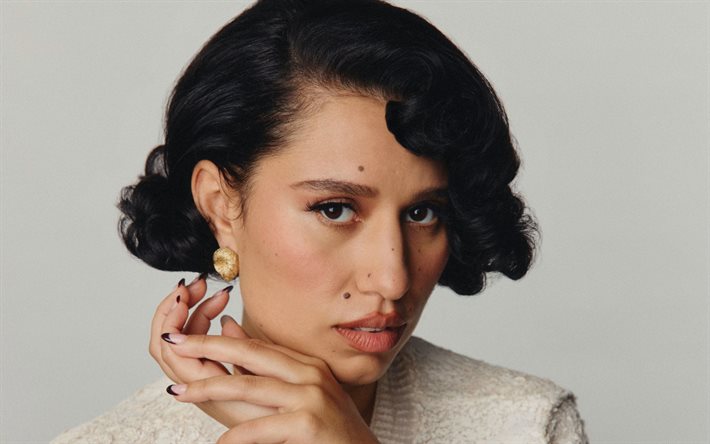
There is a particular kind of artist who does not arrive all at once. They are there in the room for years, writing the hooks, lending the voice, sharpening the pen, learning where the bodies are buried. Then suddenly, when the conditions are finally theirs, they step forward and the world acts surprised. RAYE is one of those artists.
Born Rachel Agatha Keen in South London, RAYE has always sounded like someone with more lives than the industry knew what to do with. Her voice carries the polish of a pop professional, but underneath it is something older and more bruised: jazz phrasing, gospel ache, R&B confession, blues melodrama, big-band theatre, the kind of emotional precision that makes a lyric feel half-sung, half-survived. She can glide across a dance record, then turn around and deliver a line like she is standing under a single spotlight with nothing left to hide.
Before the awards, before the standing ovations, before the myth of RAYE as Britain’s independent pop miracle, there was the songwriter. Signed young, working hard, present but not centered, she became one of those names tucked into credits before many listeners knew her face. She wrote for and around the machinery of pop, contributing to songs for major artists while also appearing on glossy dance singles that put her voice into clubs and charts. It was not that she was invisible. It was worse: she was visible in fragments.

That tension — being used, heard, but not fully allowed — is central to understanding her rise. RAYE was signed to Polydor as a teenager, but her debut album was delayed for years. In 2021, after publicly expressing frustration that she could not release a full-length project, she left the label and became independent. Her debut album, My 21st Century Blues, finally arrived in 2023 through Human Re Sources, and it sounded like someone opening every locked room at once.
The album was not neat, and that was the point. It moved through addiction, assault, body dysmorphia, industry sexism, heartbreak, self-disgust, survival, and glamour with the intensity of a woman who had been told to edit herself for too long. On “Hard Out Here,” she sharpened her frustration into a manifesto. On “Ice Cream Man,” she turned trauma into a devastating act of testimony. And on “Escapism.”, featuring 070 Shake, she made a hit out of collapse: a woozy, nocturnal spiral of alcohol, bad choices, revenge, numbness, and the awful clarity that comes after trying to outrun yourself.
That song changed everything. “Escapism.” became RAYE’s first UK number one single in January 2023, a victory made more potent by the fact that it happened after she had left the traditional label structure that had failed to deliver her debut. It was not a sanitized empowerment anthem. It was messy, funny, ugly, seductive, exhausted. It sounded like the inside of a bad night and the morning after. Pop often asks women to turn pain into something pretty. RAYE made it theatrical, but she did not make it polite.
Her lyrics work because they refuse to flatten contradiction. She is glamorous and ashamed, devastated and hilarious, wounded and vain, spiritual and deeply human. She writes like someone who understands that survival is rarely graceful in real time. There is a bluntness to her language that cuts through the lushness of the arrangements. She does not hide behind abstraction. She names the feeling, then performs around it, over it, through it, until the song becomes both confession and costume.
By the time the 2024 BRIT Awards arrived, the industry could no longer treat RAYE as a side character in her own story. She won six awards in one night — including Artist of the Year, Album of the Year for My 21st Century Blues, Song of the Year for “Escapism.”, Best New Artist, Best R&B Act, and Songwriter of the Year — setting a new record for the most BRIT wins by an artist in a single ceremony. The image was almost too perfect: an independent artist, once held back by the system, standing on its biggest stage and leaving with her arms full.
But the most interesting thing about RAYE is not that she won. It is what she chose to do with the freedom that followed.
Her second album, THIS MUSIC MAY CONTAIN HOPE., released in March 2026, expands her world rather than shrinking it to fit the streaming era. At 17 tracks and over 70 minutes, the record is ambitious, cinematic, emotionally oversized, and deliberately resistant to the idea that modern pop must be brief, minimal, and algorithmically smooth. It moves through jazz, soul, blues, orchestral pop, big band, house, spoken-word passages, and old-Hollywood grandeur, treating the album less like a playlist and more like a staged emotional epic.
The title is important: this music may contain hope. Not certainty. Not happiness. Not healing packaged as a clean brand message. Hope. The fragile, inconvenient kind. The kind that comes after self-destruction, after public doubt, after romantic wreckage, after admitting you are not okay and still deciding to sing.
The album’s lead single, “WHERE IS MY HUSBAND!”, is RAYE at her most knowingly dramatic: big, brassy, comic, theatrical, and desperate in quotation marks and exclamation points. It plays with old-school ideas of longing and romantic fantasy, but there is a wink in the performance. RAYE is too self-aware to simply play the damsel. She becomes the narrator, the character, the chorus girl, the woman in the mirror, and the woman laughing at the mirror all at once.
Then there is “Nightingale Lane.”, a more sweeping, orchestral moment that leans into her ability to make a song feel like a memory turning into cinema. RAYE’s best work often has this quality: she sings as if she is not just remembering an event, but restaging it in higher definition, adding strings, smoke, and a spotlight because the truth deserves production value.
Her collaboration with Hans Zimmer on “Click Clack Symphony.” feels like the clearest statement of where RAYE wants to go next. Zimmer, whose name is synonymous with cinematic scale, gives the song an orchestral weight that matches RAYE’s flair for drama. But the track is not simply “pop star gets film composer.” It works because RAYE already writes like a director. Her songs have blocking, costume, lighting, character, scene changes. Zimmer does not make her world bigger so much as reveal that it was already built for the big screen. The single was released ahead of the album in March 2026 and pairs contemporary pop movement with symphonic arrangement, turning the sound of heels — the titular click-clack — into a rhythm of re-entry, of a woman stepping back into life.

That is the deeper arc of RAYE’s career: not just independence as a business model, but independence as authorship. Owning the masters matters. Leaving the label matters. Proving the executives wrong matters. But the artistic independence is even more interesting. RAYE is no longer trying to choose between dance vocalist, soul singer, pop writer, jazz student, survivor, diva, or diarist. She is all of them, sometimes in the same song.
In an industry that often rewards artists for becoming easier to categorize, RAYE has become more excessive, more emotional, more musically literate, more herself. Her recent work does not smooth out the contradictions that made My 21st Century Blues compelling. It gives them an orchestra.
RAYE’s rise is often framed as revenge, and in some ways it is. But revenge is too small a word for what she is building. Revenge looks backward. RAYE is looking forward, even when she is singing from the wound. Her story is not simply that she escaped the machine. It is that once she did, she built a stage large enough for every version of herself that the machine could not hold.